
Identifying Open Door Threats in the OR to Reduce Surgical Site Infections
Operating rooms may be among the most tightly regulated environments in healthcare facilities, Sonicu helps ensure they're safe and monitored correctly.
Learn more
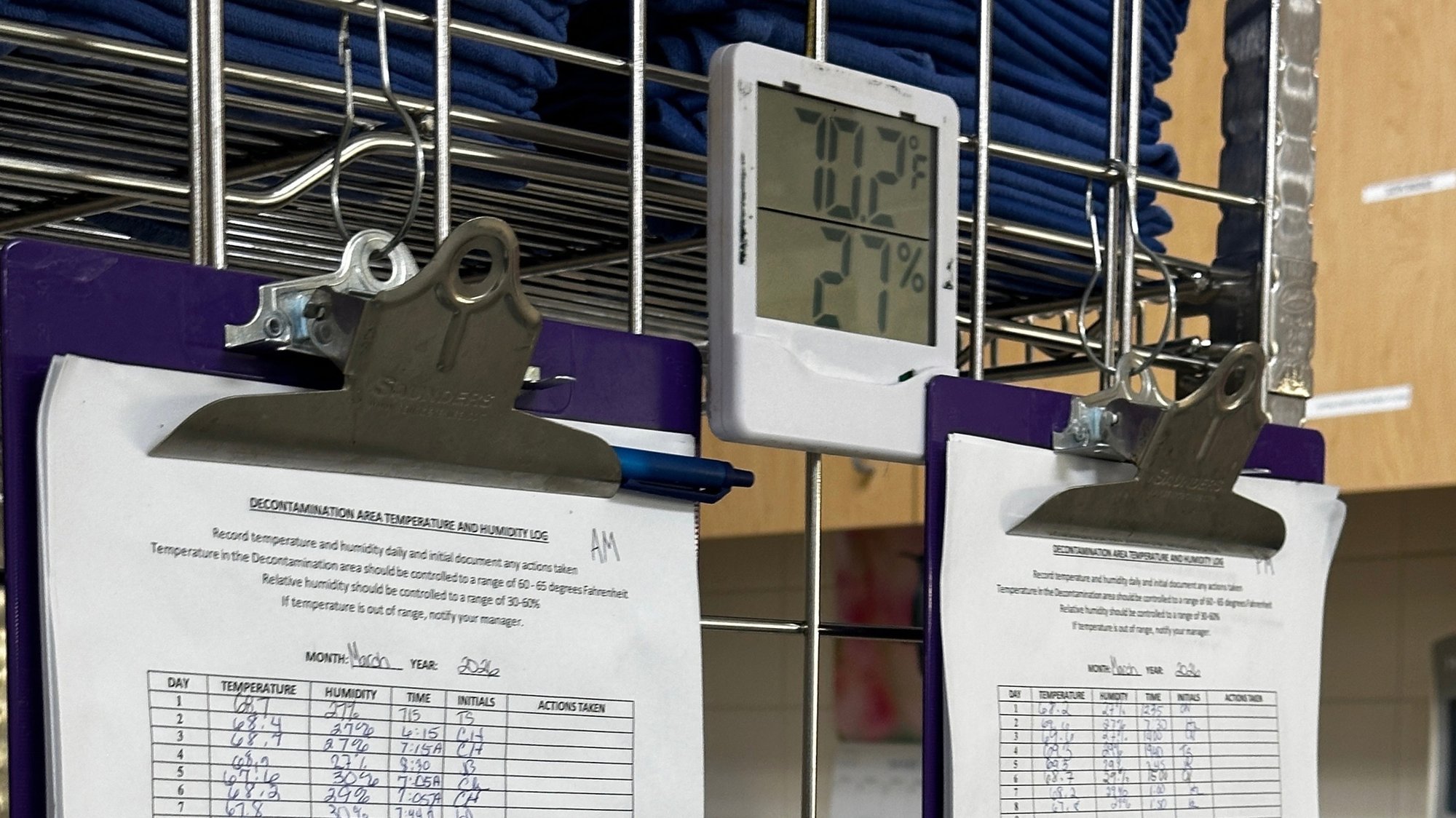
In a temperature-sensitive room, a clipboard hangs on a nail by the door. The ballpoint pen is tied on with a piece of yarn. An employee steps in, checks the display, and writes down the reading. It happens on time, most of the time.
On the surface, it’s a simple process. A few minutes, a few times a day. Across an entire operation, though, those minutes add up, and so do the risks.
Many pharmacies, hospitals, labs, schools, food service operations, and manufacturing environments still rely on paper temperature logs to track conditions.
The reason?
“It works.”
“It’s what we’ve always done.”
“It meets the basic requirements.”
Until it doesn’t.
If a refrigerator fails at 2:00 a.m., how would you know? If a freezer door doesn’t close all the way, how long will it take before someone notices? If humidity drifts out of range in a cleanroom or pharmacy compounding area, would anyone be alerted before products or processes are affected?
By the time someone discovers the issue, the damage may already be done.
What looks like a low-effort task carries hidden operational and financial cost. Time is pulled away from more valuable work. Factor in limited staff and the impact is even greater. Gaps in data go unnoticed. And when something goes wrong, teams are left reacting instead of responding with confidence.
Paper logs don’t just delay response; they leave long periods where no one knows what’s happening.
The real costs of manual temperature logging aren’t always obvious. It happens gradually through staff time, gaps in data, increased risk exposure, and can even show up all at once in a single, preventable incident.
A temperature check might take five minutes. That doesn’t sound like much until you multiply it across a year.
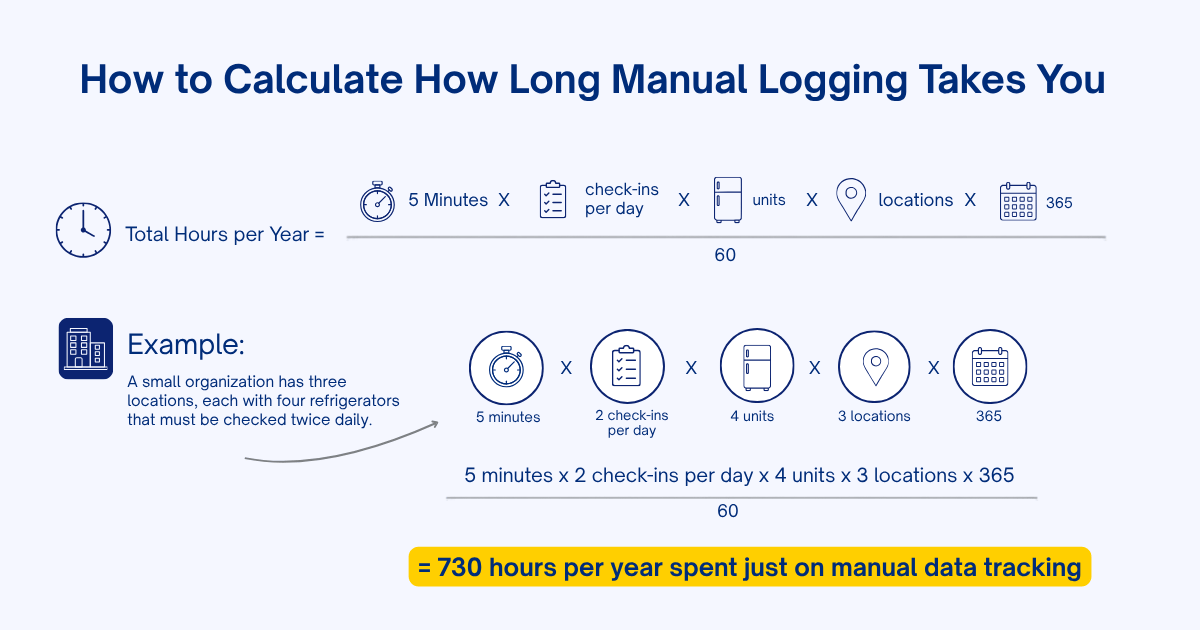
For example, twice-daily checks on just four refrigeration units across three locations equal 730 hours of staff time annually. That’s more than four full-time months of labor spent walking to equipment, recording temperatures, and filing paperwork! Multiply that across multiple departments or facilities, and the hidden labor costs become hard to ignore.
What starts as a quick task can turn into hundreds of staff-hours annually. That’s time spent walking, checking, and recording data. This disrupts the employee’s workflow, taking away time that could be directed towards higher-value work.
The impact extends far beyond a simple calculation of labor hours. Within the current landscape of staffing shortages and employee burnout, pharmacies, hospitals, and labs are facing significant retention hurdles. Tasking highly skilled professionals with the repetitive chore of walking to equipment, recording temperatures, and manually organizing binders for audit reviews pulls them away from critical patient care and essential work.
Modern automation isn’t about replacing your team; it’s about eliminating the tedious, manual workflows that drive workplace frustration and compound an already heavy workload.
And that’s just the beginning.
Manual temperature logging also leaves room for data gaps. In regulated environments, logs that are incomplete, difficult to read, or filled in after the fact create challenges during audits, inspections, and accreditation reviews.
When inspections come around, teams often find themselves pulling together binders, filling in gaps from memory, and trying to demonstrate compliance retroactively. Regulated organizations need accurate, defensible temperature documentation, whether they follow USP <797> and USP <800>, CDC/VFC, HACCP, or Joint Commission.
The greatest risk comes from what isn’t captured at all.
Temperature excursions don’t follow a schedule. Without continuous visibility, these events could go unnoticed until the next manual reading, which could be long after there’s an opportunity to intervene.
When that happens, the impact can be devastating. Temperature-sensitive products, from vaccines and medications to food, raw materials, and lab specimens, can be quickly compromised. A single incident could result in financial loss and could cause a disruption in operations, which can cost even more money.
Before investing in a monitoring system, SUNY Downstate Pediatrics almost lost $11,000 overnight when a vaccine fridge had been left open by mistake. Their saving grace was that it was winter, which kept temperatures low. But they didn’t push their luck after that. Today, Sonicu monitors their vaccine fridges 24/7 to ensure such a scare never happens again.
Some organizations have already moved away from paper logs, but still rely on systems that require manual interactions, such as checking a display, recording readings elsewhere, or accessing data by plugging the device into a computer with a USB cable.
While these systems may feel like an improvement, they often carry the same limitation: they depend on someone being there at the right time to catch a problem.
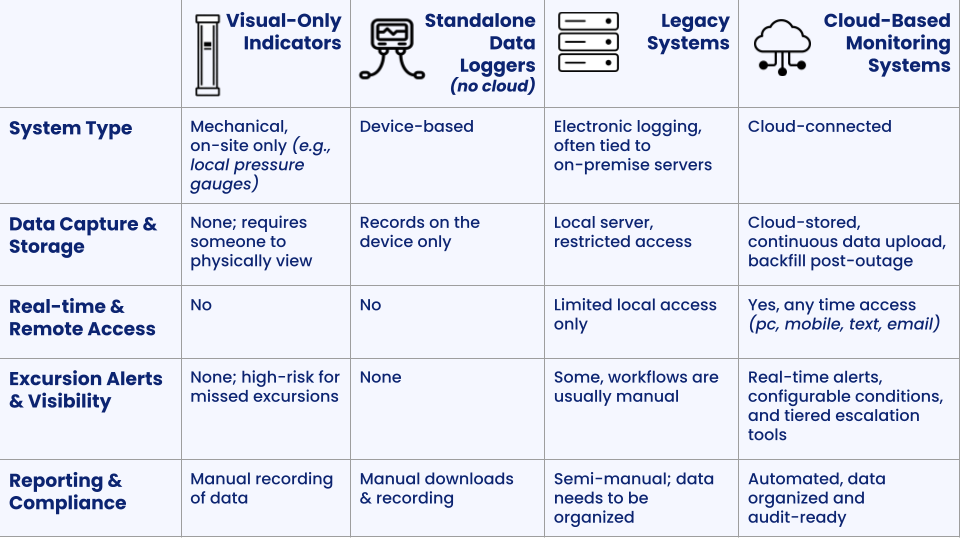
Modern temperature monitoring systems shift the role of monitoring from periodic checks to continuous awareness. They reduce the hidden costs that build over time, like lost staff hours, data gaps, and delayed response when conditions change.
That shift shows up in a few key ways:
The result is fewer blind spots, less time spent on manual processes, and greater confidence that issues will be caught and addressed before they turn into costly problems.
A Platform Approach Goes Beyond Temperature Monitoring
More than replacing individual paper logs or standalone monitoring devices, a modern platform creates a standardized approach to environmental monitoring across an organization.
Temperature, humidity, differential pressure, door status, air quality, and other critical conditions can be managed through one centralized system with consistent monitoring standards, alert workflows, documentation, and reporting. This gives teams greater visibility, reduces disconnected processes, and helps ensure every facility follows the same proactive approach to protecting critical environments.
A standardized platform approach also makes it easier to expand monitoring programs as needs evolve. Whether adding new facilities, departments, sensors, or environmental conditions, organizations can build on an established framework rather than creating new processes each time. This reduces complexity and helps teams maintain consistency as monitoring requirements grow.
At its core, the shift away from paper temperature logs changes how organizations manage risk.
Paper logs only answer one question:
What was the temperature the last time someone looked?
Modern monitoring answers a different question:
What's happening right now, and who needs to know about it?
Manual temperature logging documents what already happened. Modern temperature monitoring systems are designed to help prevent issues before they escalate.
Paper logs may still meet minimum requirements, but they come with hidden costs that add up, like lost time, incomplete visibility, and delayed response when it matters most.
Modern monitoring systems offer a more proactive approach, combining continuous data collection, real-time alerts, standardized workflows, and built-in safeguards to reduce risk and improve day-to-day operations.
Platforms like Sonicu build on that foundation with continuous monitoring, intelligent alert escalation, centralized visibility across facilities, resilient data collection during outages, and integrations that support broader operational workflows.
For organizations responsible for protecting medications, vaccines, food, laboratory samples, or sensitive manufacturing environments, the question is no longer whether paper logs can satisfy minimum requirements. It's whether they provide enough visibility to prevent the next costly incident.
If your organization is still relying on manual temperature logging, it may be worth looking beyond whether the process “works” and considering what it leaves unseen.
For many organizations, temperature monitoring is just the beginning. Modern monitoring platforms like Sonicu are designed to scale. Sonicu can also provide visibility into humidity, differential pressure, air quality, water leaks, and other environmental conditions that impact compliance and operations, giving teams a complete picture of the environments that matter.
See how your operation can benefit – schedule a brief demo with a Sonicu expert about your monitoring needs >