
Identifying Open Door Threats in the OR to Reduce Surgical Site Infections
Operating rooms may be among the most tightly regulated environments in healthcare facilities, Sonicu helps ensure they're safe and monitored correctly.
Learn more

Sonicu offers a comprehensive suite of monitoring solutions
that help organizations safeguard assets, automate compliance and reduce manual processes.
From protecting vaccines and research materials to safeguarding food service and facility operations, Sonicu’s monitoring applications cover temperature, humidity, pressure, and more. Whether you’re in healthcare, life sciences, food safety, or other industries, Sonicu provides visibility, compliance, and peace of mind across all your critical applications.
Designed with safety, efficiency and compliance always top of mind, we’ve evolved over a decade with continuous improvements from customer feedback. Serving the healthcare, research and food service industries.
Whether you're solving basic temperature monitoring needs or managing complex, multi-environment compliance, Sonicu’s full line of meters, sensors, and hubs has you covered.
Connect SoniCloud to the systems that power your operations. From BMS and pharmacy workflow software to lab management tools and third-party sensors, our flexible integrations help you centralize data, automate compliance, and boost operational efficiency.
Sonicu offers a comprehensive suite of monitoring solutions
that help organizations safeguard assets, automate compliance and reduce manual processes.
Still using paper temperature logs? Learn the hidden costs.
View Latest Blogs
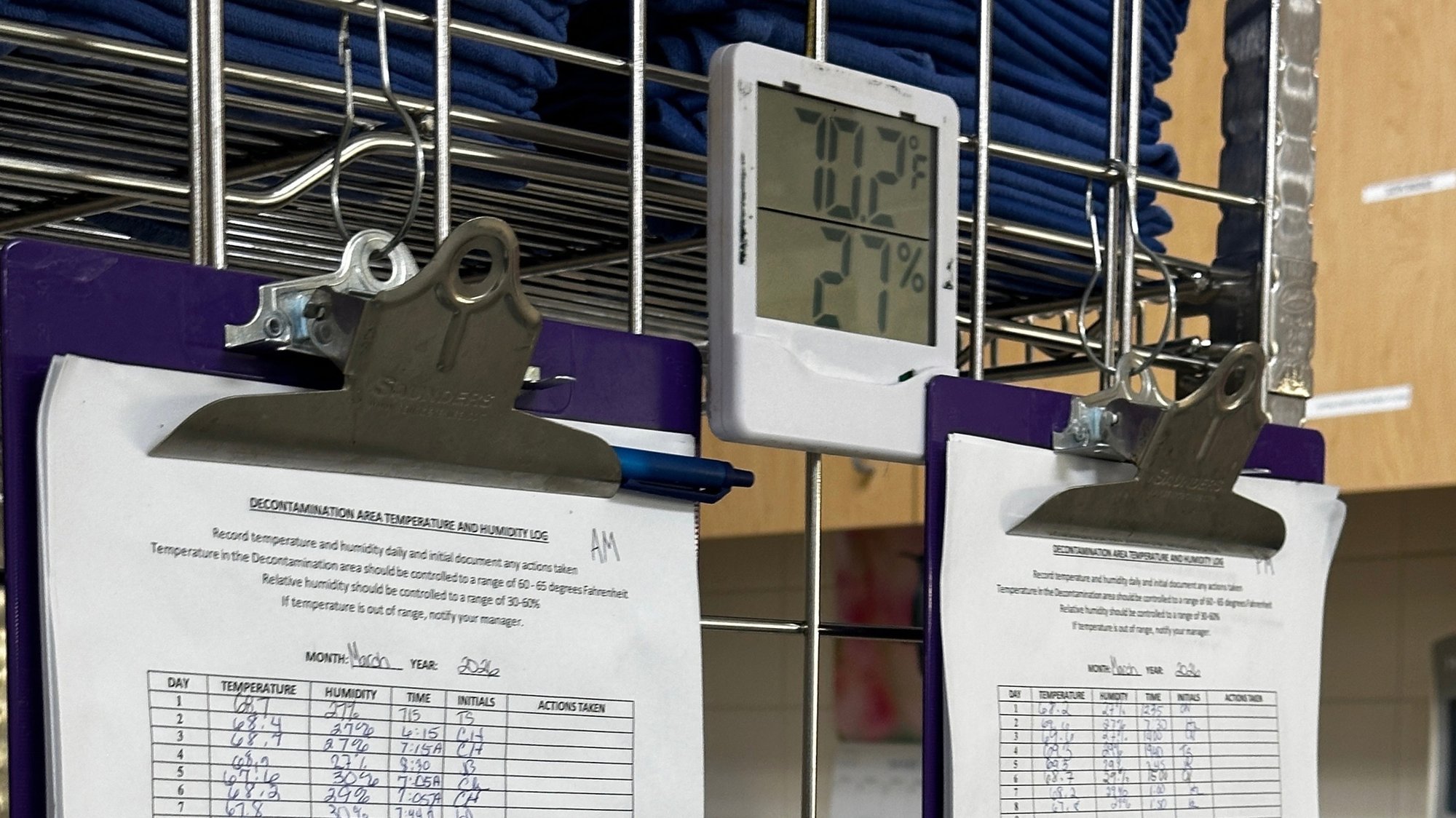
Staff arrive in the morning, open the door, and something is wrong. The temperature is out of range. Maybe it’s been that way for an hour. Maybe longer. The display shows a number, but nothing else tells the story.
The immediate questions come fast:
These questions are the same regardless of where the incident happens — a pharmacy, a hospital storage room, a research lab, a school food service operation, or a manufacturing environment. When environmental monitoring fails or lacks continuous visibility, every team faces the same challenge: not enough information to answer with confidence.
Manual temperature logs have a clear limitation in critical moments: they are static snapshots in a dynamic environment.
Some organizations upgrade from paper logs to basic digital displays or local data loggers, thinking they are fully protected. However, most basic digital monitors are simple threshold alarms, meaning that they stay completely silent until a temperature officially breaches a safety limit (e.g., crossing above 46*F). Without alerting, remote visibility, and continuous logging, someone still has to be there at the right time to catch a problem.
By the time a basic threshold alarm sounds, your inventory is already sitting in warm air.
Instead of waiting for a threshold to breach, reliable continuous tracking displays temperature trends, historical baselines, and equipment cycles over time.
When you can see on a dashboard that a refrigerator is taking twice as long to pull back down to temperature after a door close, or that temperatures are gradually creeping upward over several days, you are looking at equipment degradation in real time.
That visibility allows teams to call maintenance before a catastrophic threshold breach occurs—turning reactive firefighting into proactive prevention.
The length of an excursion determines almost everything that follows: whether the product is still viable, what needs to be discarded, and what has to be reported. Without continuous data, that answer isn't available.
That uncertainty puts teams in a difficult position across every type of temperature-sensitive operation:
When you can't establish a timeline, every decision carries financial, operational, and safety risks.
The immediate operational pressure eventually gives way to a second set of questions from auditors, accreditation bodies, regulators, or legal counsel.
The question shifts from "what do we do?" to "can we prove what happened?" Without a continuous record, there's no time-stamped evidence that conditions were maintained before the event, and no documentation of how it was detected or resolved. A fragmented paper trail is rarely enough in a formal review, and in regulated industries, the absence of proof can be as damaging as the incident itself.
Modern environmental monitoring platforms transform the situation by providing teams with the tools they need to respond effectively to issues.
Visibility
Equipment rarely fails overnight without subtle warning signs. Continuous trend tracking lets staff observe thermal drift, prolonged pull-down times, and cycling irregularities. By spotting these patterns early, teams can service aging appliances before a hard excursion threshold is ever crossed.
Remote Oversight
Conditions are tracked 24/7 across every unit, room, and facility. Centralized cloud access gives teams complete oversight from anywhere, on any device. This eliminates blind spots over weekends and holidays.
Proof
A complete, time-stamped history of environmental conditions is maintained automatically. When an audit happens, that record is already there. When a question arises about whether a product was stored properly, there’s a documented answer.
Confidence
Alerts notify the right people immediately when conditions go out of range. Escalation paths ensure that if one person doesn’t respond, the next one does. Teams don’t have to guess whether someone caught a problem; the system creates accountability at every step.
Built for Continuity When Systems Fail
Well-designed monitoring platforms continue working under difficult conditions.
Let’s return to the opening scenario where the refrigeration system stops working.
With modern environmental monitoring in place, the situation looks different from the moment the alert fires, likely hours before staff would have discovered the problem manually.
The shift is from uncertainty to clarity, and from reaction to response.
Failures happen. Equipment ages. Power grids flicker. Human error occurs. No organization can prevent every external variable.
What you can control is your ability to spot early warning trends, respond instantly when emergencies occur, and back up every compliance decision with undeniable data.
Modern environmental monitoring gives teams the proactive visibility, proof, and confidence to protect what matters most.
Don't wait for an alarm to tell you valuable inventory is ruined.
Speak to a Sonicu expert about your monitoring needs ›
Subscribe to our newsletter for expert insights, product updates, and strategies to keep your operations running smoothly.