
Identifying Open Door Threats in the OR to Reduce Surgical Site Infections
Operating rooms may be among the most tightly regulated environments in healthcare facilities, Sonicu helps ensure they're safe and monitored correctly.
Learn more

When organizations evaluate environmental monitoring systems, one phrase appears almost everywhere:
"21 CFR Part 11 Compliant."
It's an important capability—but it's also one of the most misunderstood concepts in regulated industries.
Many buyers assume that purchasing a Part 11-compliant monitoring system automatically satisfies FDA requirements. The reality is more nuanced.
FDA's guidance makes it clear that compliance depends not only on the software, but also on how organizations implement, validate, secure, and use electronic records.
Understanding that distinction can make the difference between simply collecting temperature data and being truly inspection-ready.
21 CFR Part 11 establishes the FDA's requirements for electronic records and electronic signatures used in regulated environments.
Its purpose is straightforward:
Electronic records must be as trustworthy, reliable, and authentic as traditional paper records.
For organizations monitoring refrigerators, freezers, ultra-low freezers, incubators, clean rooms, or controlled environments, this means that monitoring data often becomes part of a regulated quality system.
One of the biggest misconceptions is that the FDA expects every technical requirement of Part 11 to be implemented exactly as written.
In its guidance, the FDA explains that it exercises enforcement discretion for certain technical requirements, including some aspects of validation, audit trails, record retention, and record copying.
However, the FDA also makes something equally important very clear: that the agency continues to enforce the controls that protect the integrity, security, and reliability of electronic records.
Those controls include:
In other words, while the FDA has adopted a practical, risk-based approach, organizations are still expected to maintain trustworthy electronic records.
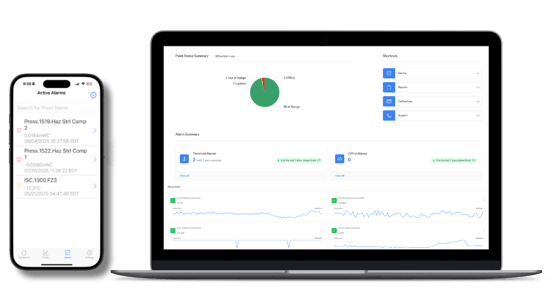
Environmental monitoring systems are often the source of critical compliance records.
These records may ultimately be reviewed during FDA inspections, Joint Commission surveys, USP compliance audits, or accreditation reviews.
A monitoring platform should do much more than send a text message when a refrigerator warms up.
It should help preserve the integrity of every regulated record.
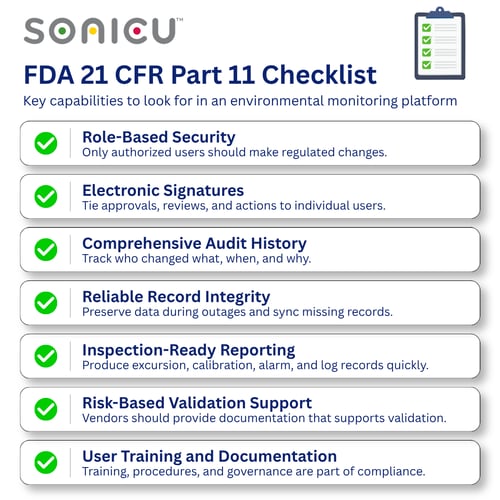
Not every employee should have the ability to modify alarm settings or acknowledge critical events.
Role-based permissions help ensure that only authorized individuals can make regulated changes.
Electronic signatures provide accountability by linking approvals, reviews, and corrective actions directly to individual users.
They become especially valuable during inspections when demonstrating who performed specific actions.
Although the FDA exercises discretion regarding certain audit trail requirements, maintaining a complete history of system activity remains a best practice.
Organizations should be able to determine:
A monitoring platform should preserve data during communication outages, automatically synchronize missing records, and maintain accurate timestamps.
Reliable records are essential for demonstrating compliance.
FDA investigators expect organizations to produce meaningful records quickly.
Generating excursion reports, calibration certificates, alarm histories, and electronic logs in common formats helps simplify inspections and audits.
The FDA encourages organizations to validate computerized systems based on risk.
Monitoring vendors should provide documentation and support that makes validation easier rather than placing the entire burden on customers.
Technology alone does not create compliance.
Proper implementation, training, documented procedures, and ongoing governance are equally important components of an effective quality system.
Perhaps the most important takeaway from the FDA's guidance is that compliance cannot simply be purchased.
Software alone cannot make an organization Part 11 compliant.
Instead, compliance is achieved through the combination of:
The right monitoring platform supports these efforts rather than becoming another compliance challenge.
At Sonicu, we've designed our monitoring platform to help healthcare organizations, pharmacies, laboratories, life science companies, and food safety professionals build confidence in their compliance programs.
SoniCloud provides capabilities including:
Our goal isn't simply to monitor temperatures.
It's to help organizations demonstrate confidence in the integrity, security, and reliability of the records they depend on every day.
.png?width=500&height=375&name=Stay%20Ahead%20of%20Compliance%20and%20Downtime%20(1).png)
FDA inspections rarely focus on whether an organization owns a particular brand of monitoring system.
Instead, inspectors evaluate whether electronic records are accurate, trustworthy, secure, and properly controlled.
Organizations that invest in systems designed around those principles are often better positioned to simplify audits, reduce risk, and protect both product quality and patient safety.
When evaluating your next environmental monitoring solution, don't just ask whether it's "Part 11 compliant."
Ask whether it's built to support true inspection readiness.
Understanding the requirements of 21 CFR Part 11 is only the first step. Organizations also need monitoring systems that support secure electronic records, user accountability, auditability, and long-term record integrity.