
Identifying Open Door Threats in the OR to Reduce Surgical Site Infections
Operating rooms may be among the most tightly regulated environments in healthcare facilities, Sonicu helps ensure they're safe and monitored correctly.
Learn more

Not all temperature monitoring systems are created equal. While cost is an important consideration, it shouldn’t be the only factor driving your decision.
The true cost of a monitoring system often isn’t realized until a compliance gap, equipment failure, or product loss occurs. Before you invest, here’s what department leaders and decision-makers often miss when comparing temperature monitoring systems.
If you’re in healthcare, chances are you monitor medications, vaccines, or blood products. If you work in a laboratory, you deal with biological specimens, reagents, or other temperature-sensitive assets that may be impossible to replace (such as years of research). If you oversee an industrial facility, you have to manage working conditions for the safety and comfort of your staff, all while also protecting inventory from the elements.
While each industry is different, they share a few things in common:
By choosing the correct temperature monitoring device from the beginning, organizations can save themselves the trouble of catching temperature excursions too late, which can cost thousands in lost assets and possibly a penalty from an auditor.
Temperature excursions aren’t necessarily caused by negligence. In fact, they can develop gradually over a long stretch of time without anyone noticing. Let’s look at a common scenario we see with our customers who experience gradual temperature drift.
The image below depicts historical temperature readings from a clinical trial freezer. The data shows a 5-degree spike that never stabilized and continued at a higher range over the course of a month.
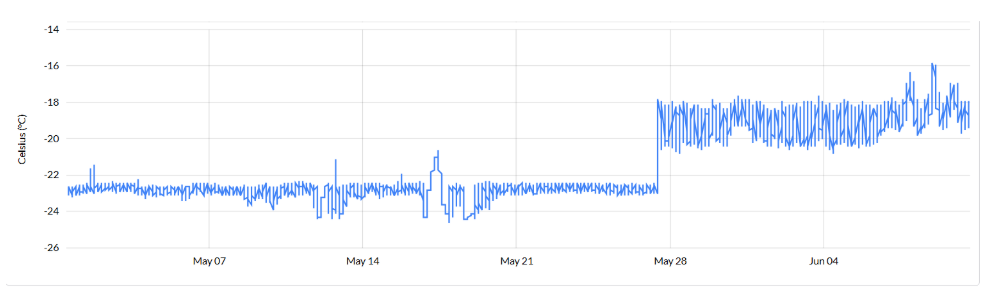
This phenomenon is typically linked to a deeper issue, such as a failing compressor or a clogged fan.
But whatever the cause, it’s important to investigate while the issue is still mild. If it turns out to be a more serious matter, further delaying action could lead to a more expensive and stressful discovery two months from now.
Let’s say a team member looks at this data and shrugs it off. Technically, the data is still reading in range, so we’re good. Right?
Here's a better question: Is it really worth it to wait until it is out of range?
Say it does turn out the initial temperature spike was due to a bad compressor. Now that the freezer reads out of threshold, maintenance has to order a replacement part, which can take 1-2 business days to arrive.
With the freezer out of commission for a couple of days, the clock is ticking for the items stored inside. So the staff has to hurry and move them to another freezer. This causes needless stress and takes time away from the work teams could have been doing instead, impacting labor costs and overall productivity.
One delayed proactive action can cause a wave of reactive decision-making that could have been prevented. Choosing the right temperature monitoring device makes all the difference.
Manual thermometers can read room temperature and can help you catch an excursion. But they aren’t a perfect system. Here's why this is not the ideal temperature monitoring device for modern workplaces, particularly if you work in a highly regulated industry.
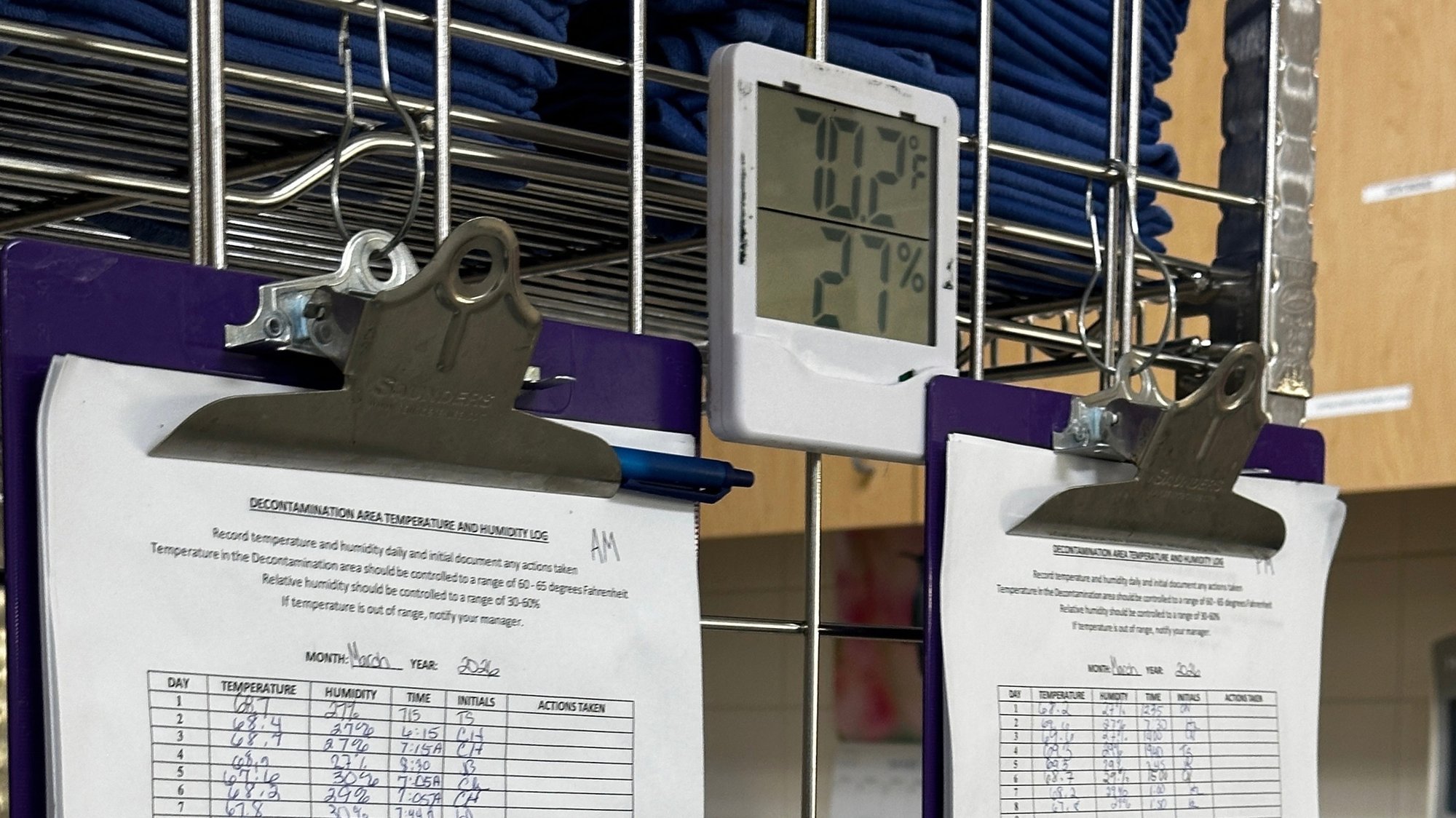
You’ll only catch a temperature excursion on a thermometer by checking it right as it happens. A temperature check at 8 a.m. and another at 4 p.m. won’t tell you about the temperature spike that happened around lunchtime.
Consistent manual spot checks require a staff member to devote minutes out of the workday to check the thermometer, and likely input the reading onto a paper log or on a spreadsheet. During a particularly hectic workday, they may miss a reading or record the wrong temperature by mistake. Auditors won’t accept human error as the answer for gaps in temperature data, making thermometer readings not only a matter of inefficiency, but also a potential compliance issue.
High humidity levels can lead to contamination and mold growth in a space that must remain sterile for the safety of patients, compounded drugs, or other humidity-sensitive materials within the space.
Thermometers only show temperature readings, which is only half of the picture. Not knowing humidity levels is another crucial data gap that could be a compliance risk, a quality control issue, and a safety concern.
A thermometer doesn’t have any sort of alarm mechanism to inform you if conditions drift outside of safe thresholds. If a fridge compressor malfunctions at 3 a.m. and temperatures rise throughout the night, and no one is there, how would you find out about this? If you’re only working with a thermometer, chances are you’d show up the next morning and find your fridge full of assets that are completely thawed and ruined.
Relying on thermometer readings alone puts environments at risk of huge monitoring gaps. With continuous data monitoring, facilities can easily close these gaps using modern features, such as automated temperature monitoring.
Data loggers are an improvement over manual temperature logs, but they are still a legacy monitoring technology that limits real-time visibility, delays response to excursions, and creates unnecessary compliance blind spots.
While a data logger automatically logs temperatures for you, that's pretty much all it does. You still have to manually retrieve the data either by removing a memory card or by plugging the logger directly into your computer. That extra step might seem minor, but it's just the beginning of the problem.
Because data has to be transferred manually, you won't know about a temperature excursion until after you've reviewed the collected readings. By then, it may be too late to save your assets.
The whole point of a temperature monitoring device is to give you peace of mind while you're away. If you wake up at 3 a.m. worried about temperatures at your facility, a basic data logger gives you no choice but to physically drive there to check. Remote temperature monitoring via cell phone, with real-time alert notifications and system-wide visibility from anywhere. This eliminates that doubt. But even if alerts aren't your biggest concern, data loggers create another burden you may not have considered.
Once the data is collected, your job still isn't done. You have to manually build reports from scratch, typically in a spreadsheet, then store them in a folder or as a digital file and hope you can find them when an auditor comes calling. If that sounds familiar, you're working too hard.
Fortunately, monitoring technology has advanced well beyond basic data loggers. Modern systems let you generate reports directly from where the data is stored. Just a couple of clicks, and you're audit-ready 24/7. That's the power you get from an automated temperature monitoring device connected to a cloud database.
Manually retrieving data, catching excursions too late, and building reports from scratch just won’t cut it in a regulated environment. The best temperature monitoring device will make work so much easier by automatically logging temperatures, simplifying compliance, and keeping the right people informed of any deviating readings in real-time.
The only solution capable of all that is a sophisticated environmental monitoring system (EMS). Here's how you know if a system is cut out for the job:
As more monitoring systems enter the market, it's easy to focus on feature checklists and product specifications. But those details don't tell the whole story. The real differences often show up in compliance, system capabilities, implementation complexity, long-term reliability, and the total cost of ownership. Consider key features that separate a system worth investing in from one that will cost you headaches later.
The ideal temperature monitoring system combines a flexible, scalable architecture with the tools to keep your organization compliant 24/7.
If you manage multiple locations, you know every facility has its own unique challenges. Factors like building construction, location, and layout can all impact connectivity, making flexibility an important consideration when evaluating a temperature monitoring system.
For example, old buildings are notorious for connectivity issues, especially with cell signal. Yet, many monitoring systems solely rely on cellular connectivity.
If you have a facility based in a remote location, or some departments are in the basement, a cellular monitoring system may experience spotty service, leaving your data vulnerable.
The best temperature monitoring system will offer more than one way to connect, so each location can operate however they see fit. We highly recommend selecting a product with LoRaWAN connectivity for better reach with less hardware, which saves money in the long run.
Data gaps — including those caused by network outages — can be called into question in an audit. That’s why it’s critical to consider a system that comes with multiple sources of data redundancy so your data trail stays intact. Otherwise, data protection is your responsibility.
Some systems will require customers to use external storage as a backup strategy, putting more work on your teams. The best system will have built-in redundancy as a standard, to offload that burden from their customers.
Most environmental monitoring systems today include real-time alerts, which are essential for better asset protection. However, systems without advanced notification controls often generate too many alarms, increasing the risk of alarm fatigue.
The best temperature monitoring system includes intelligent alarm management features like role-based notifications, alert escalation, and maintenance mode. These tools help reduce nuisance alarms while ensuring critical events appropriately reach the right people at the right time.
To make the most of a temperature monitoring system, the best will allow you to check in at any time, from anywhere. This is made possible through a web-based cloud platform that you can access from a PC, tablet, or even your smartphone.
The best cloud-based platform will have the following features included:
Many industries now require automated monitoring with a secure cloud storage service. If your industry does not yet, it might in the future. Investing in a system with this feature now will prevent rushing to find a system that works best when it is mandated.
A strong system will offer a range of temperature monitoring sensors, such as glycol-buffered sensors for monitoring liquid assets, non-buffered sensors for air temperature monitoring, etc. The best system will have the capabilities to consolidate non-temperature monitoring onto the same platform, so teams only have one platform to log into during the workday.
If you work in a highly regulated environment, be wary of any sensors that claim to be good for everything. Different environments call for different sensors for a reason. Overlooking this puts you at risk of non-compliance.
Sonicu's environmental monitoring system checks every box. With flexible LoRaWAN connectivity, built-in data redundancy, smarter alarm management, and a cloud-based platform that generates compliance reports automatically, Sonicu takes the complexity out of temperature monitoring, so your teams can focus on more valuable work.
Whether you manage a single facility or dozens of locations, Sonicu scales with your needs and keeps you audit-ready 24/7 with no hidden fees. Our 100% wireless options make it easy to get started without any assistance from IT.
Don't wait for a costly excursion to find out your current system isn't enough. Fill out this form or give us a call at (317) 468-2345 to speak with a Sonicu representative today.
SoniCloud is Sonicu’s cloud-native monitoring platform with an iOS/Android mobile app to enable remote access to real-time data and active alerts 24/7. SoniCloud also comes with its own built-in reporting suite, where customers can automate data reports or generate them on demand.
Sonicu offers a wide range of wireless monitoring, which we recommend starting with if you need monitoring right away. We also have hardware available to accommodate regulatory-specific monitoring needs, including real-time local displays and buffered sensors. View our hardware.
Automating any data recording tasks saves thousands of hours of fieldwork. Real-world time studies show switching from manual logging to Sonicu has proven to save organizations the equivalent of the salary of two full-time employees.
The SoniCloud Platform uses aggregated dashboards that allow multi-site operators to manage 1 or 100+ facilities from a single view, enforcing uniform automated reporting and eliminating manual paper logging across all locations. Sonicu’s dedicated Customer Success team is here to help you through implementation and will continue to support you and your teams moving forward.