
Identifying Open Door Threats in the OR to Reduce Surgical Site Infections
Operating rooms may be among the most tightly regulated environments in healthcare facilities, Sonicu helps ensure they're safe and monitored correctly.
Learn more

Contamination events do not wait for scheduled data downloads. Leading controlled environment facilities are moving to continuous, cloud-based particle monitoring to gain visibility they previously never had.
Picture this: somewhere in your cleanroom, a failure has already occurred. A seal degraded. A door remained open slightly too long. The equipment released particles outside of the specification. The contamination is invisible, airborne, and spreading.
When do you find out?
For many facilities operating under traditional monitoring workflows, the honest answer is: too late.
Data collected today is downloaded tomorrow, reviewed days later, and archived before meaningful investigation begins. By then, the product has shipped, batches have been released, and the originating event may be buried in historical data, if it is identified at all. Industry guidance from ISPE and GMP environmental monitoring frameworks emphasizes that contamination excursions can occur between scheduled sampling intervals, meaning short-duration events may go undetected when relying solely on periodic monitoring.
Facilities adopting real-time cloud monitoring are closing the gap between when an event occurs and when action begins. That gap often carries greater operational risk and financial exposure than organizations realize.
In semiconductor manufacturing, only a few minutes of elevated particle counts can result in hundreds of thousands of dollars in scrapped material. In pharmaceutical production, a compromised batch triggers quarantine, investigation, and significant loss. In automotive paint environments, a single 5-micron particle can create a visible defect discovered only after finishing layers are complete.
These are not rare incidents. They represent the daily reality of controlled environment operations. Yet many monitoring systems were designed for periodic review rather than continuous awareness.
At one customer facility, a laser printer introduced into a cleanroom experienced a toner cartridge failure. The contamination was invisible to personnel but immediately detected by a particle counter connected to a live cloud monitoring platform. Operators watched the particle plume migrate across the room in real time, identified the root cause, documented corrective action, and preserved a complete audit trail before the shift ended.
Without continuous monitoring, the event likely would have gone unnoticed. With real-time visibility, the facility gained immediate control of the situation.
Unlike traditional periodic sampling, continuous monitoring systems provide immediate visibility into contamination risks
Cloud-based environmental monitoring represents a shift in operational philosophy rather than simply a technology upgrade. Traditional wired systems often require weeks or months to deploy and involve substantial infrastructure investment. Modern cloud-connected systems can be operational within a day, without new wiring or production disruption.
Operational advantages extend well beyond installation speed:
Data redundancy remains one of the most overlooked differentiators. Many off-the-shelf wireless solutions transmit data only in real time. Network interruptions can permanently erase readings generated during downtime. Enterprise monitoring systems store data locally and automatically transmit buffered records once connectivity returns, preserving a complete and defensible history.
Modern cleanroom monitoring extends beyond particle counting. Effective programs unify environmental data into a single operational view, so teams are not forced to reconcile multiple systems.
Through Sonicu’s integrated monitoring environment, facilities can monitor:
In day-to-day operations, door open/close monitoring quickly proves its value. When particle spikes align precisely with door activity, investigations that previously required days of analysis can be resolved in minutes.
.svg)
Real-time visibility requires more than a particle counter operating in isolation. It requires particle intelligence connected to operational context.
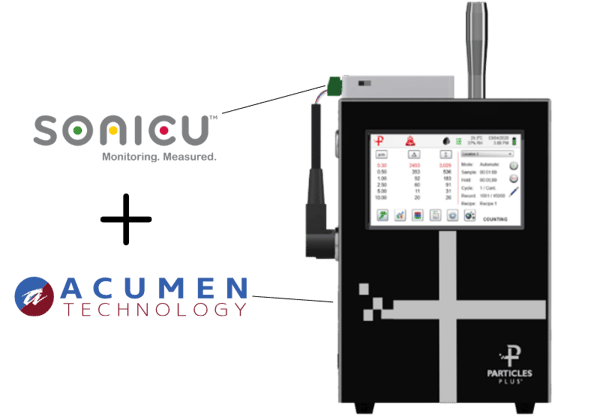
Sonicu’s integration with Acumen particle counters combines high-precision particle measurement with continuous cloud monitoring and automated compliance workflows. Acumen instruments provide industry-leading particle detection accuracy, while the Sonicu SoniCloud platform centralizes data, delivers instant alerts, and maintains a secure, inspection-ready record.
Together, the integrated solution transforms particle monitoring from a periodic validation exercise into a continuous operational control system. Particle excursions, environmental changes, and facility events are viewed together in real time, allowing teams to identify root cause faster and respond before contamination impacts product quality or compliance status.
For pharmaceutical manufacturers and compounding pharmacies, environmental monitoring is a regulatory requirement. The challenge is not whether monitoring occurs, but how reliably documentation supports compliance.
Cloud-based monitoring automatically generates inspection-ready records. Every reading is timestamped, secured within a complete audit trail, and immediately accessible for inspection without manual preparation. Risks associated with edited spreadsheets, misplaced storage devices, or incomplete downloads are eliminated.
.png?width=600&height=450&name=Stay%20Ahead%20of%20Compliance%20and%20Downtime%20(1).png)
Real-time particle monitoring supports any operation where contamination carries financial or regulatory consequences:
These industries share common priorities: high-value products, tightly controlled environments, and minimal tolerance for undetected contamination. Continuous monitoring protects product quality, strengthens compliance posture, and enables faster operational response.
Organizations adopting real-time monitoring are not simply solving known problems. They are uncovering risks that previously went undetected and addressing them before they escalate.
Real-time monitoring delivers more than faster alerts. It provides continuous understanding of cleanroom performance every hour of every day.
The question is no longer whether contamination events occur. The question is whether your team sees them soon enough to act.
What is continuous particle monitoring?
Continuous particle monitoring measures airborne contamination in real time rather than through periodic manual sampling.
Why is real-time monitoring important for cleanrooms?
It reduces response time, protects product quality, and strengthens compliance documentation.
Does cloud monitoring support FDA compliance?
Yes. Modern cloud monitoring systems support FDA compliance by automatically recording environmental conditions, preserving tamper-resistant audit trails, and maintaining inspection-ready electronic records required under cGMP regulations.