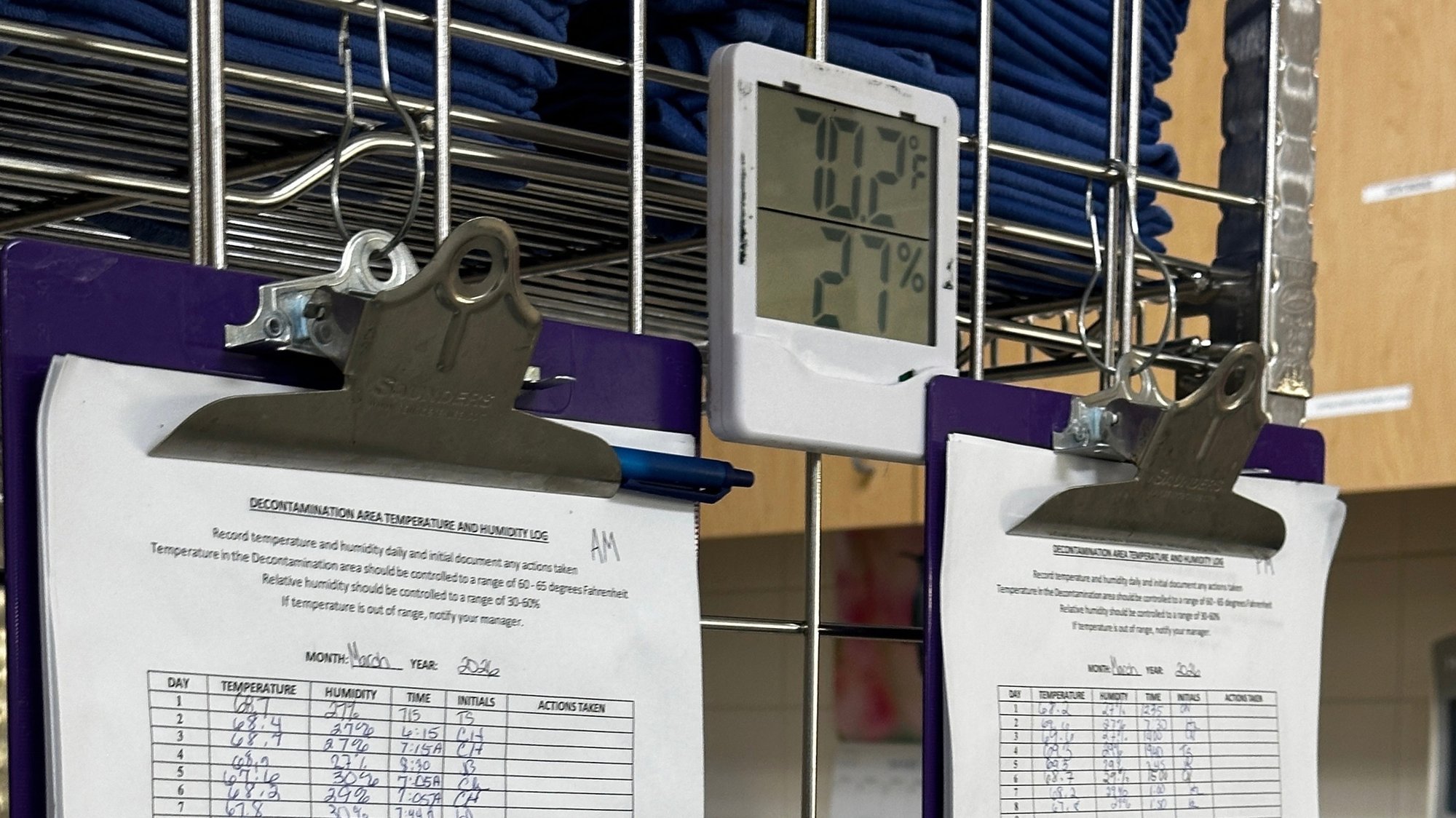

Identifying Open Door Threats in the OR to Reduce Surgical Site Infections
Operating rooms may be among the most tightly regulated environments in healthcare facilities, Sonicu helps ensure they're safe and monitored correctly.
Learn more

In addition to conferring specific rights about health insurance coverage and portability, it also specifies how personal health data is to be protected from unauthorized disclosure, theft, and fraud.
As with most government regulations, the law is complex and not always easy to understand.
Given the legal complexity and the potential for significant penalties for violating the law, it’s easy to understand why healthcare practitioners and the healthcare industry in general are skittish about any avenue that might give an intruder access to the medical record vault.
It also hasn’t helped that healthcare system hacks continue to rise, and the threat isn't going away.
Ransomware attacks continue to target healthcare enterprises, prompting Raymond Pompon, principal threat researcher with F5 Labs, to opine in April 2017 that “Ransomware has proven itself as an existential threat to medical service delivery in modern hospitals.”
Significant sums are being spent protecting against the ongoing IoT security hack, and exponentially more is at risk for victims.
In light of this volatile situation, why would anyone trust an IoT system to monitor temperature, humidity, air pressure, and other room conditions within their healthcare enterprise?
The answer is simple. Condition monitoring only transmits condition data—temperature, humidity, air pressure—and, in many cases, the monitoring platform does not integrate with an enterprise IT or building automation/control system for monitoring and reporting.
Sonicu wireless monitoring, for example, can operate entirely off an existing IT or BAS system to monitor environmental conditions across a campus or an entire network of offices.
Sonicu’s sensors sit in the client facility and never touch the client’s internal network. Sensor data is transmitted via 900 MHz radios (internal to the sensors) to a central cellular gateway, then to Sonicu’s Amazon Web Services platform.
900 MHz radios typically provide a superior radio signal compared to WiFi and Cellular, and are cost-effective. Furthermore, 900 MHz radios can “mesh,” providing a self-healing, reliable network.
This is an ideal option for clients with many sensors in a single area who can share a single cellular data plan.
The gateway utilizes a cellular modem to send data packets to SoniCloud. All traffic sent from the cellular modem is encrypted via a VPN and decrypted by Sonicu at AWS, ensuring data remains protected as it travels over the internet.
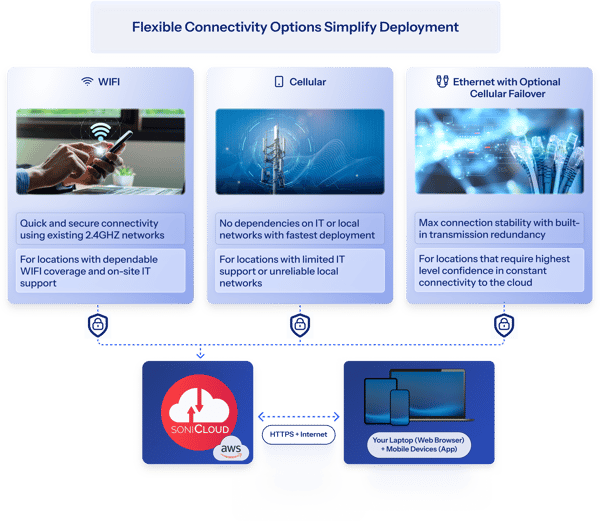
Additionally, most Sonicu sensors can serve as both a sensor and a data gateway by using an internal cellular modem. This is an ideal option for locations that wish to use cellular transmission and have a small number of sensors at each location.
Furthermore, Sonicu monitors and records only environmental data, such as the temperature of cold storage equipment, room temperature, humidity, sound, and air pressure, and only this data is transmitted.
As a result, Sonicu devices do not monitor PHI or other HIPAA-related information.